Darn it…..I thought we did everything right!
Feras Mahdi
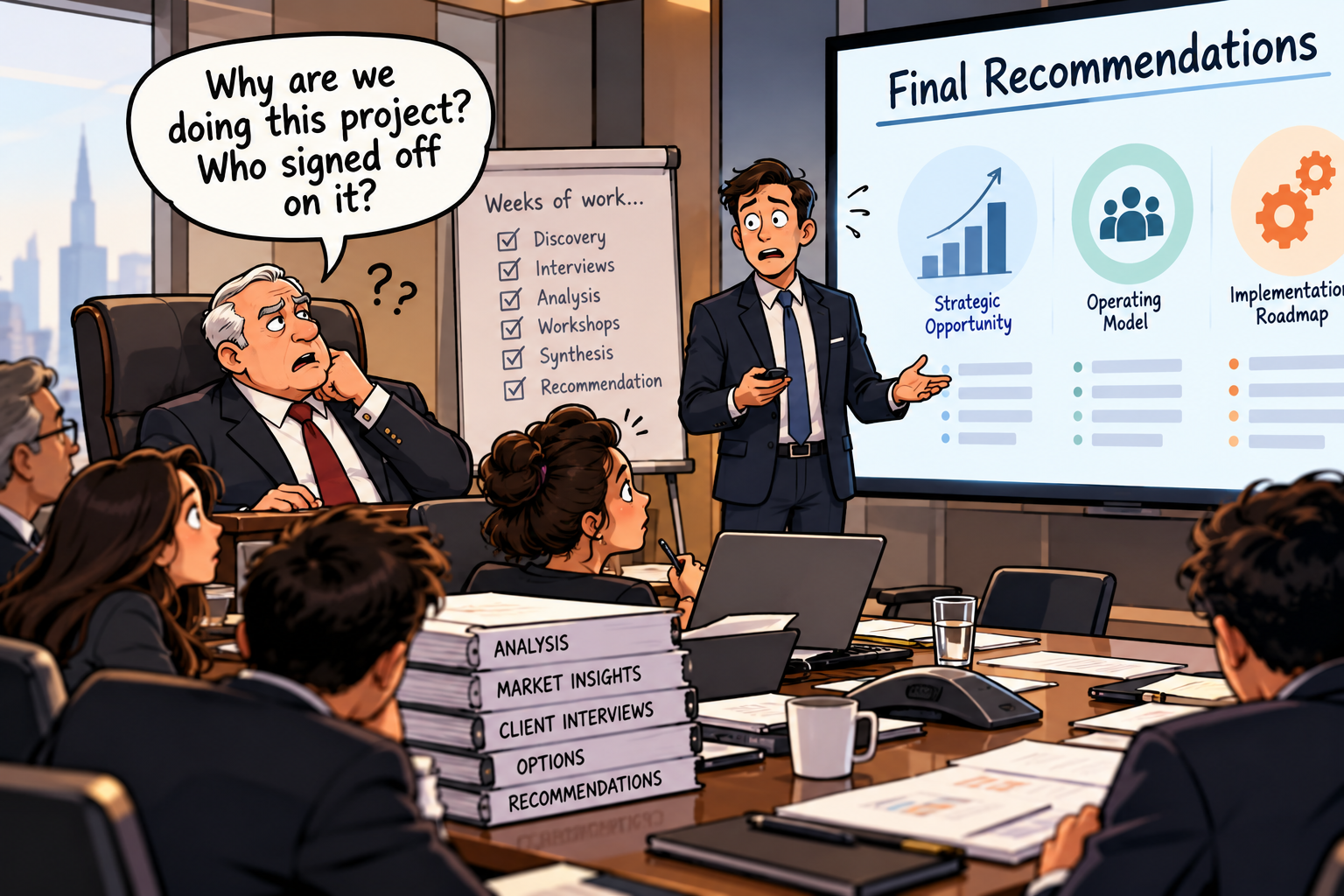
In the final presentation of a consulting engagement, a senior stakeholder who has attended none of the working sessions and read none of the pre-reads will occasionally walk into the room and ask, with genuine curiosity, why the project was commissioned in the first place. The team has spent weeks building toward this moment. The recommendation is coherent. The analysis is sound. And yet the next forty-five minutes are spent relitigating first principles.
This is not a rare occurrence. It is a recognisable pattern, and it tends to be misread as resistance or as hostility to the process. More often it is neither. It is the predictable consequence of a senior leader arriving in a formal setting without having been adequately prepared for what they are about to encounter. Someone exposed to a process they should have helped shape, finding the most available response is to question it.
The discomfort in that room is a symptom. The cause is almost always a failure of client-side engagement that could have been prevented weeks earlier.
The joint system that determines outcomes
Consulting firms invest considerable effort in building high-performing project teams. The internal dynamics matter: the quality of trust, the capacity for productive disagreement, individual accountability, and a collective orientation toward results rather than personal visibility. These are genuine determinants of the quality of the work produced.
They are not, however, sufficient determinants of whether that work produces a durable outcome.
A team that is analytically capable, operationally disciplined, and internally well-aligned can still fail to deliver a result that changes anything. The reason is straightforward: a consulting engagement is not a solo performance. It is a joint system, and the quality of what gets produced depends on both sides of that system functioning adequately. When the client side is absent, distracted, or insufficiently engaged, the analysis may be excellent and the impact negligible.
This is the part of project delivery that receives the least systematic attention, and it is often where outcomes are actually determined.
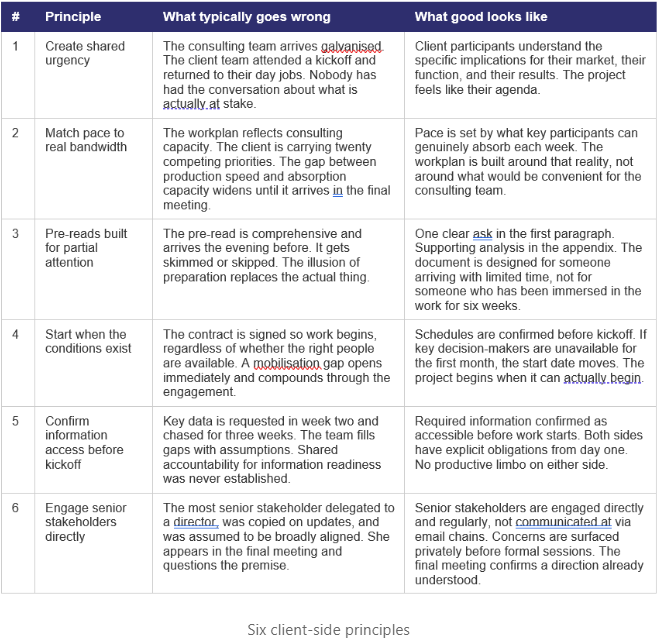
What follows are six areas where the best consulting teams invest deliberate effort on the client side of that system.
1. Create shared urgency on the client side
A consulting team typically arrives at a project with a clear sense of why it matters. They have engaged with the diagnostic, shaped the scope, and developed a considered view of what is at stake. The client team, in most cases, has not been through an equivalent process.
The client team approved a budget and attended a kickoff. That is not the same as understanding the specific implications for their market, their function, and the decisions they will need to make in the coming months. The gap between a team that believes in the work and one that is tolerating it is consequential, and it opens early.
The best consulting teams address this directly and specifically. A commercial leader needs to understand the revenue implication for her territory. A regional director needs to understand what the findings mean for the decisions she faces. A medical or operational leader needs to know this connects to outcomes she is actually accountable for, rather than representing another corporate initiative that will dissolve in implementation.
Without that grounding, the project asks people to prioritise work they have no real stake in, alongside everything else competing for their attention. The absence of genuine client-side engagement rarely announces itself early. It tends to surface in the final meeting, when it is most difficult to address.
2. Match the pace of the engagement to real client bandwidth
One of the more persistent structural problems in consulting engagements is the mismatch between the pace at which a consulting team produces work and the pace at which a client organisation can absorb it.
A consulting team is singularly focused on the engagement. Their attention, their time, and their professional incentives are all oriented toward producing and advancing the work. A senior client participant is not in that position. She is managing a commercial territory, leading a team, responding to board requests, and attending to the full range of responsibilities her role requires. The consulting engagement is one of many claims on her attention, and rarely the most urgent.
When workplans are constructed around the consulting team's delivery capacity rather than the client's absorption capacity, a gap opens. The team advances. The client falls behind. Working sessions proceed on the assumption that previous material has been processed when it has not. By the time the final presentation arrives, the client is several steps behind the analysis, and the room that was expected to confirm a direction becomes a venue for a conversation that should have happened much earlier.
Addressing this requires honesty at the outset about the bandwidth that actually exists. How much genuine time can the key client participants give each week, given their other commitments? The workplan should be calibrated to that reality. A three-week delivery that the client cannot meaningfully engage with is not a successful three-week delivery. It is a document produced on a timeline that served the consulting team's schedule rather than the engagement's objectives.
3. Design pre-reads for the reality of how they will be read
There is a tendency in consulting to treat the pre-read as a vehicle for comprehensive preparation: a document that, if read carefully, would bring the client fully up to speed with where the analysis has reached. The impulse is understandable. The assumption it rests on is not.
Senior client participants receive the pre-read in conditions that are rarely conducive to careful reading. It arrives the evening before a meeting, alongside other materials they were also supposed to review. It is opened on a phone during travel, or scanned at a desk between other commitments. The forty-five minutes of focused engagement that would be required to process a detailed document is not available.
A pre-read that does not get read has not prepared the client. It has created the administrative record of a preparation step while the actual preparation gap remains intact.
The discipline this requires is a willingness to edit ruthlessly. What is the single thing this person needs to understand before the session begins? What decision or input are they being asked to provide? The answers to those two questions should determine the content of the document. The supporting analysis belongs in an appendix, available to those who want it, not positioned between the executive and the point.
4. Begin the engagement when the conditions for it actually exist
The signing of a contract and the commencement of substantive work are not the same event, though they are frequently treated as though they are.
A project is genuinely underway when the people whose engagement is required are available, oriented, and in a position to participate meaningfully in the work. When that condition is not met, an engagement that has started commercially has not started substantively. Work is being produced, but there is no functioning client system positioned to receive it.
If the client project lead is absent for the first two weeks, if the senior stakeholders whose alignment is essential have travel commitments that occupy the first month, the project faces a structural problem that beginning anyway will not resolve. It will instead produce a gap between the progress of the analysis and the client's ability to engage with it, a gap that widens and then tends to manifest as a crisis in the final stages of the engagement.
The appropriate response is a conversation that project leaders are often reluctant to have before a contract is signed: given the actual availability of the relevant participants over the coming weeks, when is it realistic to begin? Deferring a start date by two weeks to ensure the right conditions exist is not a failure of momentum. It is the kind of early decision that prevents considerably more difficult conversations later.
5. Establish shared accountability for information readiness before work begins
Engagements that begin without the information they require do not resolve the deficit through goodwill. They stall, substitute assumptions for data, and spend time in the early weeks of an engagement pursuing access to material that should have been confirmed as available before the work started.
This is a shared responsibility that is frequently treated as though it belongs to one side of the table. The consulting team has an obligation to identify what they will need and to confirm access before committing to a timeline. Discovering in week two that a critical dataset requires three weeks to extract is not an external constraint. It is a planning failure that could have been addressed in the mobilisation phase.
The client organisation has a corresponding obligation. Once an engagement is live, information requests are not discretionary. They represent commitments made when the project was approved, and treating them as low-priority items that will be attended to when time permits introduces costs that are absorbed, often silently, by the engagement as a whole.
The engagements that proceed most cleanly tend to be those where someone, before anything else began, was explicit about what would be required, when it would be required, and what the consequences for the timeline would be if it was not available. That conversation is straightforward. Its absence tends not to be.
6. Engage senior stakeholders directly, and do not assume that absence indicates alignment
Among the failure modes that are easiest to rationalise and most damaging in their consequences is the assumption that a senior stakeholder who is not actively engaged with an engagement is nonetheless broadly supportive of its direction.
The pattern is familiar. A stakeholder at the most senior level is nominally connected to the project but consistently unavailable. Their schedule does not permit active participation. They have delegated day-to-day involvement to a direct report. They are included in distribution lists but are not expected to review materials in detail. The engagement proceeds. The delegated director is engaged and constructive. Progress appears to be made.
Then the senior stakeholder participates in the final steering session.
What follows is not difficult to predict. A leader who has not been a genuine participant in the development of the work encounters its conclusions for the first time in a formal and public setting. They have questions about the framing. They have a different view of the priority. They raise concerns that, had they been surfaced six weeks earlier, could have been addressed with relative ease. The team's instinct is to defend the work. The more productive question is whether anyone had spoken with this person directly, at any point in the engagement, to test whether the direction being pursued reflected their actual view.
A full calendar is not a satisfactory explanation for the absence of that conversation. It is, at most, a reason why the conversation required more persistence to arrange.
Senior stakeholders who are not actively engaged in an engagement are not quietly endorsing it. They are accumulating reactions and reservations that have not yet had an occasion to surface. The discipline of ensuring that important participants encounter significant recommendations before formal sessions, in conditions where concerns can be raised and addressed privately, is not a courtesy. It is a fundamental element of managing the conditions under which the work will land.
The standard that matters
The visible markers of a successful engagement — analytical rigour, on-time delivery, a well-constructed final presentation — are necessary but not sufficient. The question that provides a more demanding and more honest assessment is whether anything changed because the work existed: whether revenue improved, a strategic decision was made with greater clarity, a risk was reduced, or a capability was built that would not otherwise have been.
Projects that clear the visible markers but fail the harder test almost always do so for reasons that originated on the client side of the engagement. The team that was never genuinely galvanised. The senior stakeholder who was present in name but never in substance. The pre-read that created an administrative record of preparation without the preparation itself. The start that proceeded before the conditions for a productive start existed.
None of these are failures of analysis. They are failures of engagement design, and they are the responsibility of the consulting team to anticipate and prevent.
The most capable project leaders treat the client's experience of the engagement as a design problem of equal standing to the analytical work itself. They build the conditions under which the client can absorb, decide on, and ultimately act on what the team produces. That orientation is what separates engagements that deliver a document from engagements that deliver a change.